
The United States Patent and Trademark Office issues an official warning! Beware of fraudulent information in overseas trademark registration!
The United States Patent and Trademark Office (USPTO) issues an official warning: “Fraudsters are conducting large-scale scams through forged emails, counterfeit websites, and impersonation of attorneys!” Is your trademark secure? Control over your brand may be under covert threat. Understanding the official guidelines is like adding a firewall to your cross-border business!
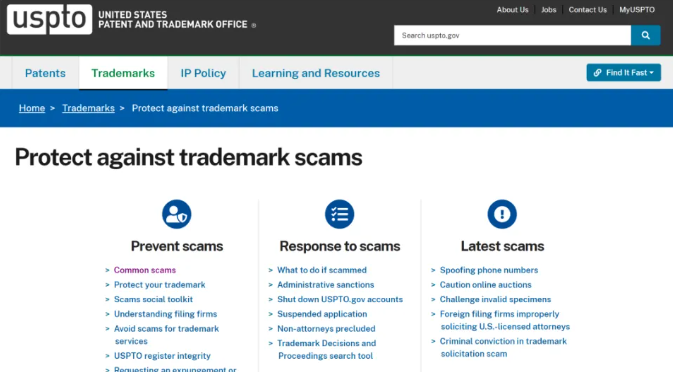
If any of the following occur, it is 100% a scam:
Requesting personal or payment information via phone, email, or text message;
Demanding payment to third parties via wire transfer, gift cards, or cash;
Asking for your USPTO account password;
All official emails end with “@uspto.gov”;
Official website domains are exclusively USPTO.gov or my.USPTO.gov. Any names like “Patent and Trademark Office” or “Trademark Renewal Service,” or domains without “.gov,” are fraudulent;
Claims of “USPTO recommendations” are fraudulent. The USPTO never endorses any company or attorney. Only trademark owners themselves or licensed U.S. attorneys may file documents or handle litigation with the USPTO.
Why do scammers know your information?
The first question many ask after receiving a scam letter is: How was my information leaked?
The truth is, it's not a leak—it's a side effect of the public system. The U.S. trademark registration system is completely open and transparent. The moment you file an application, your name, address, and trademark details enter a public database.
They exploit this public data to mass-produce personalized-looking notices and mail them to applicants worldwide.
Cross-border sellers emerge as primary victims
Most affected sellers are small-to-medium-sized cross-border enterprises. Limited resources and insufficient compliance experience during startup phases mean that even properly registered trademarks can fall prey to scammers due to lax post-registration monitoring.
Some sellers had their Amazon registrations invalidated and listings hijacked after email addresses were altered and verification codes stolen.
Others had their USPTO accounts compromised and trademarks directly transferred after clicking fraudulent links.
Common Scams and Tactics
1. Fake Websites
Scammers replicate USPTO.gov or my.USPTO.gov to trick you into mistaking their site for the official one. Their goal is typically to steal your personal or payment information.
Countermeasure: Carefully examine the domain name. The official USPTO domains are USPTO.gov or my.USPTO.gov
2. Impersonating Phone Numbers
Scammers call trademark applicants, falsely claiming to be from the U.S. Patent and Trademark Office. They use spoofed caller ID to impersonate USPTO staff, tricking you into providing personal information or paying excessive or non-existent fees. They may claim your application won't be assigned to an examiner or proceed through registration unless you pay certain “missing” fees.
Note: USPTO employees will never request personal or payment information via phone, email, or text message.
Report suspicious websites or calls to: TMScams@uspto.gov
3. Impersonation Emails
These emails are the most deceptive—scammers accurately cite your trademark application number, registration number, or even forge “Office Actions” claiming “additional documents and fees are required,” complete with a “submission link.”
Countermeasures:
Check the email domain: Any address not ending in “@uspto.gov” is fraudulent.
Verify via TSDR: All official USPTO communications (including Office Actions and payment notices) are uploaded to the “Documents” tab in the Trademark Status and Document Retrieval (TSDR) system. Any email not found in TSDR is a scam.
4. Fraudulent or Misleading Notices
You may receive deceptive or misleading email notifications. Scammers attempt to persuade you to use their services, claiming you face hefty fines, loss of trademark rights, or risk losing your application or registration. These notices can appear at any stage—before filing, after filing, or even after trademark registration is complete.
These solicitations attempt to appear legitimate, often incorporating terms like “USA,” “Trademark,” “Office,” or “Agent” in their business names. Do not be misled by offers for services you do not need or that are typically unnecessary.
Countermeasures:
Verify Information: Cross-check any “employee names” or “deadlines” mentioned against official records in the TSDR.
Check Company Credentials: If they claim to handle USPTO matters, confirm they have a licensed U.S. attorney (non-lawyer entities lack authority).
Examine Details: Note typos in company names (e.g., “USDTO” instead of “USPTO”).
5. Email Hijacking
Fraudsters modify the contact email in your USPTO trademark application/registration without your consent. Once successful, verification codes sent by platforms like Amazon for brand registration will be redirected to the scammer's email, enabling them to impersonate you and seize brand control.
Countermeasures:
Regularly log into your USPTO.gov account to verify no changes have been made to your “Contact Information”;
If you receive a platform verification code you did not initiate, immediately contact both the USPTO and the platform to freeze your account.
6. Impostor Attorneys and Illegal Agents
Some so-called low-cost registration platforms claim they can handle your application without a U.S. attorney, citing “experts” on staff.
U.S. law mandates that applicants residing abroad must be represented by a U.S.-licensed attorney. Entities without U.S. attorney credentials not only violate regulations but may also forge attorney signatures or steal attorney accounts to submit applications. If discovered, your trademark application could be invalidated immediately.
7. Providing False Addresses and Fabricated Evidence
Some applicants submit fake U.S. addresses or forge usage evidence (e.g., Photoshop images, e-commerce screenshot generators).
Important Reminder:
Upon discovery, applications will be rejected or re-examined; registered trademarks may be revoked.
All materials must truthfully reflect actual market usage of the trademark.
8. Misrepresenting Goods/Services Scope
To expand protection, some declare unused categories.
Important Reminder:
You may be selected for use evidence verification;
Face third-party “Expungement” or “Reexamination” proceedings;
Severe cases may directly invalidate the trademark.
How to Effectively Guard Against Trademark Service Scams?
1. Beware of “Low-Price” Traps
Official fees for trademark registration, renewal, and related services are clearly defined. If an agency quotes prices significantly below market rates, it's highly likely a “low-price bait-and-switch” tactic—luring clients with low fees only to hike prices later, or even absconding with the money altogether.
2. Rigorous Verification of Attorney Credentials
Regardless of how you find an attorney, confirm two key points:
They are registered with the bar association of a U.S. state or territory and maintain good standing;
They can provide a license certificate and refuse “verbal assurances.”
3. Conduct Regular Self-Checks
Log into your USPTO.gov account monthly to verify the “trademark status,” “contact email,” and “attorney of record” for any anomalies. Simultaneously review the TSDR system to confirm no unprocessed official notices exist.
4. Keep Official Contact Information
Save these phone numbers/emails to your phone and contact them directly with questions—do not rely on “third-party relay”:
Trademark Assistance Center (TAC): 1-800-786-9199
Fraud Reporting Email: TMScams@uspto.gov
Attorney Credential Reporting Email: OED@uspto.gov
 Everything You Need to Know Ab
The United States Patent and T
【Effective 2026】Major Update t
The 2026 European EPR renewal
Everything You Need to Know Ab
The United States Patent and T
【Effective 2026】Major Update t
The 2026 European EPR renewal