USPTO Proposes New U.S. Patent Rule: Foreign Applicants Must Be Represented by U.S.-Based Attorneys! Sellers Must Immediately Conduct Compliance Self-Audits!
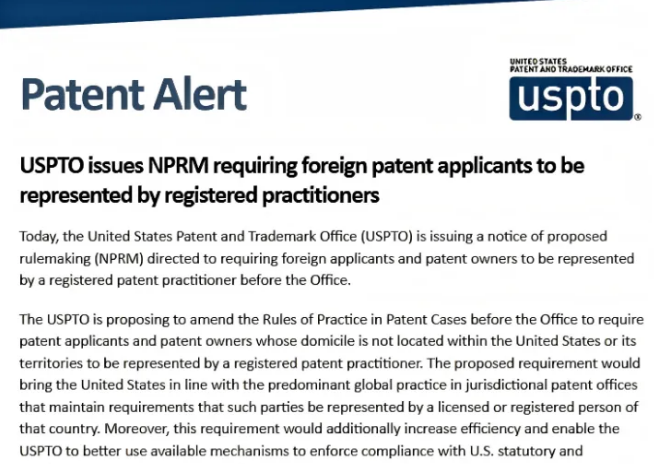
Recently, the United States Patent and Trademark Office (USPTO) issued a proposed rulemaking notice, planning to mandate that all foreign patent applicants and patent holders not residing in the United States must appoint a U.S.-registered patent practitioner (attorney or agent) to handle their affairs. This signifies a major shift in U.S. patent applications, transitioning from “permitted self-filing” to “mandatory licensed representation.”
According to data disclosed by the USPTO, while over 99% of foreign patent applications are filed through U.S. agents, approximately 1,200 “pro se” applications are still submitted annually. These applications often contain significant procedural deficiencies, substantially consuming examination resources.
What are the core changes in the proposed rule?
1. Comprehensive prohibition on non-U.S. applicants practicing pro se
Whether filing an initial application, responding to examination notices, or processing ownership transfers, all documents must be signed by a registered patent practitioner if the applicant or patent owner resides outside the United States. This requirement applies even to the form for paying the grant fee (PTOL-85B).
2. Combating fraud as the primary driver
The USPTO acknowledges a sharp rise in recent years in fraudulent microentity certifications (to fraudulently obtain fee reductions) and forged documents. When self-represented applicants abandon their applications, the USPTO cannot track or investigate them. Registered agents, however, are bound by the USPTO Code of Professional Conduct and have a duty to cooperate with investigations. Violations may result in disciplinary action—effectively attaching a “regulatory tracker” to every application.
3. Aligning with International Practices to Reduce Process Costs
Currently, most national patent offices worldwide require foreign applicants to engage local registered agents, such as those in the EU, Japan, and South Korea. This USPTO adjustment effectively aligns with international norms, reducing procedural disparities and cross-cultural communication costs in cross-border patent matters while enhancing processing efficiency.
Who is affected?
This regulation has far-reaching implications, primarily targeting the following entities:
1. All individual inventors who are non-U.S. residents
They will no longer be able to file patent applications directly with the USPTO.
2. Companies and enterprises headquartered outside the United States
This includes all Chinese enterprises planning to enter or already engaged in patent布局 in the United States.
3. Entities submitting applications through non-standard channels
The new regulation aims to eliminate low-quality or fraudulent applications submitted via non-professional agencies.
What does this mean for Chinese cross-border sellers?
On one hand, it indeed raises the bar for cross-border sellers. The era of securing U.S. patents by “hiring any cheap agent for convenience” may truly be coming to an end.
On the other hand, it benefits sellers focused on originality and brand-building. This regulation will weed out many players who have been exploiting the market with “fake patents and fake originality.” For sellers willing to invest effort in refining their products and seriously pursuing intellectual property strategies, it presents an opportunity to “clean up the playing field.”
Regardless of whether this regulation ultimately takes effect, the strong signals currently being sent by the USPTO indicate that the U.S. patent system is moving toward higher standards and stricter oversight.
For instance, they have recently launched a large-scale investigation, reviewing over 2,000 patents suspected of non-compliance at once. Even if you already hold a patent certificate, it doesn't necessarily mean you're “in the clear.” More stringent reviews and concentrated clean-up efforts are likely to follow.
 Hurry up and renew your UK tra
USPTO Proposes New U.S. Patent
Major Copyright Benefit in the
AliExpress is mandating the up
Hurry up and renew your UK tra
USPTO Proposes New U.S. Patent
Major Copyright Benefit in the
AliExpress is mandating the up